
Finding Your Voice Under Pressure
From Overthinking to Authority: Communicating with Confidence in High-Stakes Moments

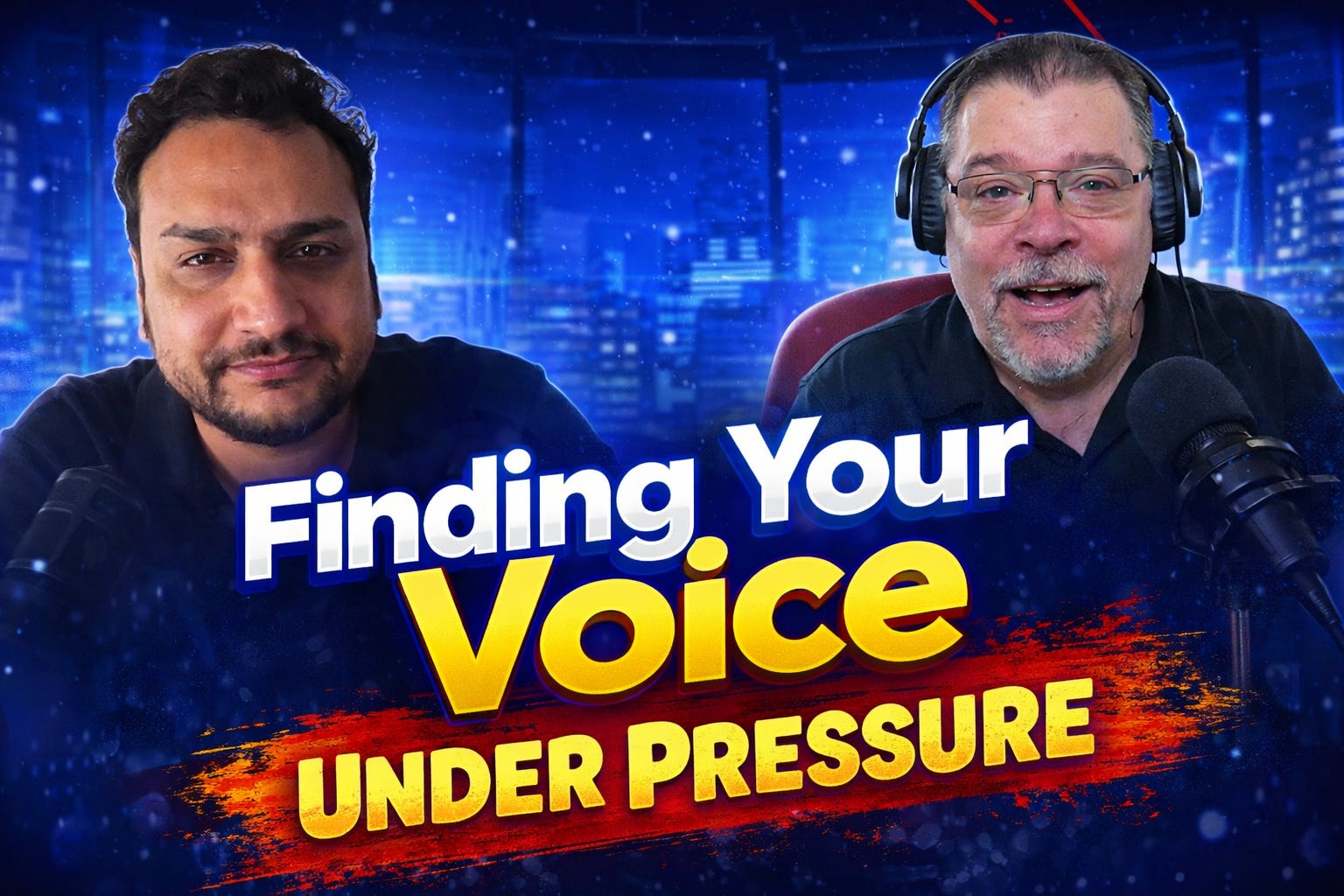
I’ve had a lot of conversations on this stage, but this one felt different. Maybe it’s because the topic hit close to home. Or maybe it’s because so many of us myself included have lived this exact experience.
You know your stuff, you’ve done the work, you’ve got the answer and then you get the moment and something shifts.
When Waqas urRehman came on, he didn’t open with perfection, he opened with truth. He shared how he once stood in front of a camera representing his country only to freeze completely when asked a simple question. What came out next? His words, not mine… “gibberish.” That moment became the foundation for everything he does today.
The Real Problem Isn’t Skill
Early in our conversation, I asked him something simple:
“Why do even experienced leaders struggle to communicate clearly?”
His answer reframed everything. It’s not a knowledge problem; It’s a nervous system response. When the pressure hits, your body doesn’t care how smart you are.
It defaults to fight, flight or freeze. That’s the moment where clarity disappears.
The Gap We Don’t Talk About
We spent a good part of the conversation unpacking what Waqas calls the gap:
The gap between how well you think… and how clearly you communicate it.
And I’ve seen it.
You’ve probably seen it too.
The most experienced person in the room…
isn’t always the one leading the conversation.
Why Simple Wins
At one point, I had to ask:
“Why do simpler ideas sound more convincing?”
Waqas didn’t hesitate. Because complexity doesn’t land under pressure.
Simplicity does. When we overcomplicate using jargon, trying to sound impressive we lose people and worse we lose ourselves.
His advice?
Keep it simple enough that anyone in the room can follow even if they don’t share your technical background.
Q&A Moment: What Do You Do When You Freeze?

I literally lost my train of thought mid-conversation.
And instead of hiding it… we leaned into it.
Q: “What do you do when your mind goes blank?”
His answer:
Be honest
Involve your audience
Ask for help if needed
Because the problem isn’t freezing…
It’s how you respond when you do.
That right there? That’s a reframe most people need.
The Biggest Shift: Before You Speak
One of the most powerful parts of the conversation was this idea:
Waqas doesn’t just help people “speak better.”
He helps them think differently before they speak.
He broke it down into three core areas:
Preparation
Content
Speaker Identity (how you see yourself)
And that last one… that’s where the real work is.
Because if your internal narrative is shaky, no amount of practice will save you in a high-pressure moment.
A Personal Truth We Both Agreed On
Somewhere in the middle of the conversation, we landed on something real:
We’re all craving human connection.
In a world filled with polished posts and AI-generated content…
people are looking for something real.
And that’s why vulnerability matters.
Waqas put it perfectly:
When you show up as your authentic self and unpolished, people connect.
Final Takeaway
If you take nothing else from this conversation, take this:
Those nerves you feel before speaking? They’re not the problem. They’re the signal that what you’re about to say matters and when you learn to work with them not against them everything changes.
If you’ve ever walked into a conversation knowing the answer… but struggled to land your message this one’s for you.
🎥 Watch the replay and take the first step toward closing that gap.
If you’re ready to build your voice and own your presence:
👉 Join Your Stage Live, because your message deserves more than silence.